The nine pictograms
Each is a black symbol on a white diamond with a red border. The names below are the official ones used in the classification list - worth knowing, because a safety data sheet names them rather than describing them.
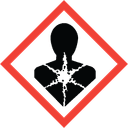
- health hazard
- Longer-term harm: cancer, damage to organs, harm to the unborn child, asthma from breathing it in.
- exclamation mark
- Irritates skin or eyes, causes an allergic skin reaction, or makes you drowsy.
- corrosion
- Burns skin, damages eyes, or corrodes metal.
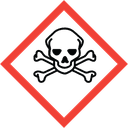
- skull and crossbones
- Acutely toxic. A small amount can kill or cause serious harm quickly.
- flame
- Catches fire easily - the liquid, the vapour, the gas or the dust.
- flame over circle
- Oxidiser. Makes a fire burn harder, and can start one without a flame.
- gas cylinder
- Gas under pressure, or a refrigerated gas that burns on contact.
- exploding bomb
- Explosive, self-reactive, or capable of detonating when heated.
- environment
- Hazardous to the water environment. Do not let it reach a drain or a watercourse.







What a symbol tells you, and what it does not
A pictogram tells you a kind of hazard. It does not tell you how much of it, at what concentration, or whether the job you are about to do is a problem.
Two products can carry the same corrosion diamond and be a world apart: one a dilute cleaner, the other a concentrated acid. The diamond is the same, the hazard statement underneath it is not, and the exposure limit, if the substance has one, is where the real answer lives.
That is the honest limit of a symbol, and the reason a COSHH assessment is about the job rather than the label.
Which of them are COSHH's business
Not all nine. COSHH is about health, so the health hazard, exclamation mark, corrosion and skull and crossbones diamonds are the ones that usually put a substance in its scope.
Flame, flame over circle, gas cylinder and exploding bomb are physical hazards: their home is DSEAR and fire risk assessment. The environment diamond is neither - it is about what happens if the substance reaches a drain or a watercourse.
A substance can carry both kinds at once, and then it needs both assessments. Petrol is the everyday example on a site: flammable under DSEAR, and harmful to health under COSHH.
Danger, Warning, and the codes underneath
Beside the diamonds a label carries a signal word - *Danger* for the more severe category, *Warning* for the less. Under them sit the hazard statements: a code and a sentence, like *H315 Causes skin irritation*.
The sentence is the useful part and the code is how it is looked up. Anything beginning H3 is a health hazard - the ones COSHH is about. H2 codes are physical; H4 are environmental.
H350 May cause cancer. H317 May cause an allergic skin reaction. H335 May cause respiratory irritation.
Retained CLP Regulation (EC) 1272/2008, Annex III - legislation.gov.uk
Questions people ask
- How many COSHH symbols are there?
- Nine hazard pictograms. Strictly they are CLP pictograms rather than COSHH symbols - CLP governs how a substance is classified and labelled, and COSHH governs what an employer does about the risk.
- What does the exclamation mark symbol mean?
- It warns of irritation to skin or eyes, an allergic skin reaction, or effects like drowsiness. It is a health hazard, so it usually puts a substance within COSHH's scope.
- What is the difference between the exclamation mark and the health hazard symbol?
- The exclamation mark covers shorter-term effects such as irritation and sensitisation. The health hazard symbol, the figure with a starburst on the chest, covers serious longer-term harm: cancer, damage to organs, harm to the unborn child, and asthma caused by breathing something in.
- Are COSHH symbols the same as safety signs?
- No. Hazard pictograms are red-bordered diamonds on product labels under CLP. The blue circles, yellow triangles and green signs on walls and doors are safety signs under the Health and Safety (Safety Signs and Signals) Regulations 1996.